
Sustain the Wave:
Turning a Perishable Surge into a Permanent Foundation
by Joyce MacDonald, Bill Davis, and Michal Heiplik

Many of you are focused on building your station’s budget for the upcoming fiscal year. You’re looking at spreadsheets, calculating renewal rates, and trying to forecast what will work in FY27.
With an incredible year of giving behind us, many of you are asking: “How do I plan for next year? What are the right investments to make in fundraising? What can I expect as this year’s ‘crisis giving’ levels off and we settle into a new norm?”
We are in uncharted territory. While public media saw a historic surge in support in 2025, this wave is as perishable as it is powerful. The decisions we make in this budget cycle will determine whether this is a one-time spike or a permanent foundation for our future.
A Historic Moment for Public Media
The data from this past year reinforces this opportunity. Public media gained a once-in-a-generation wave of newly upgraded donors as a direct result of the loss of federal funding. Donors retained from Calendar Year 2024 were responsible for two-thirds of incremental revenue in Calendar Year 2025. And an astonishing 42% of the total increased revenue came from donors giving $5,000 or more annually.
A large percentage of the new revenue came from existing donors who chose to give substantially more in CY25 than they did in CY24.
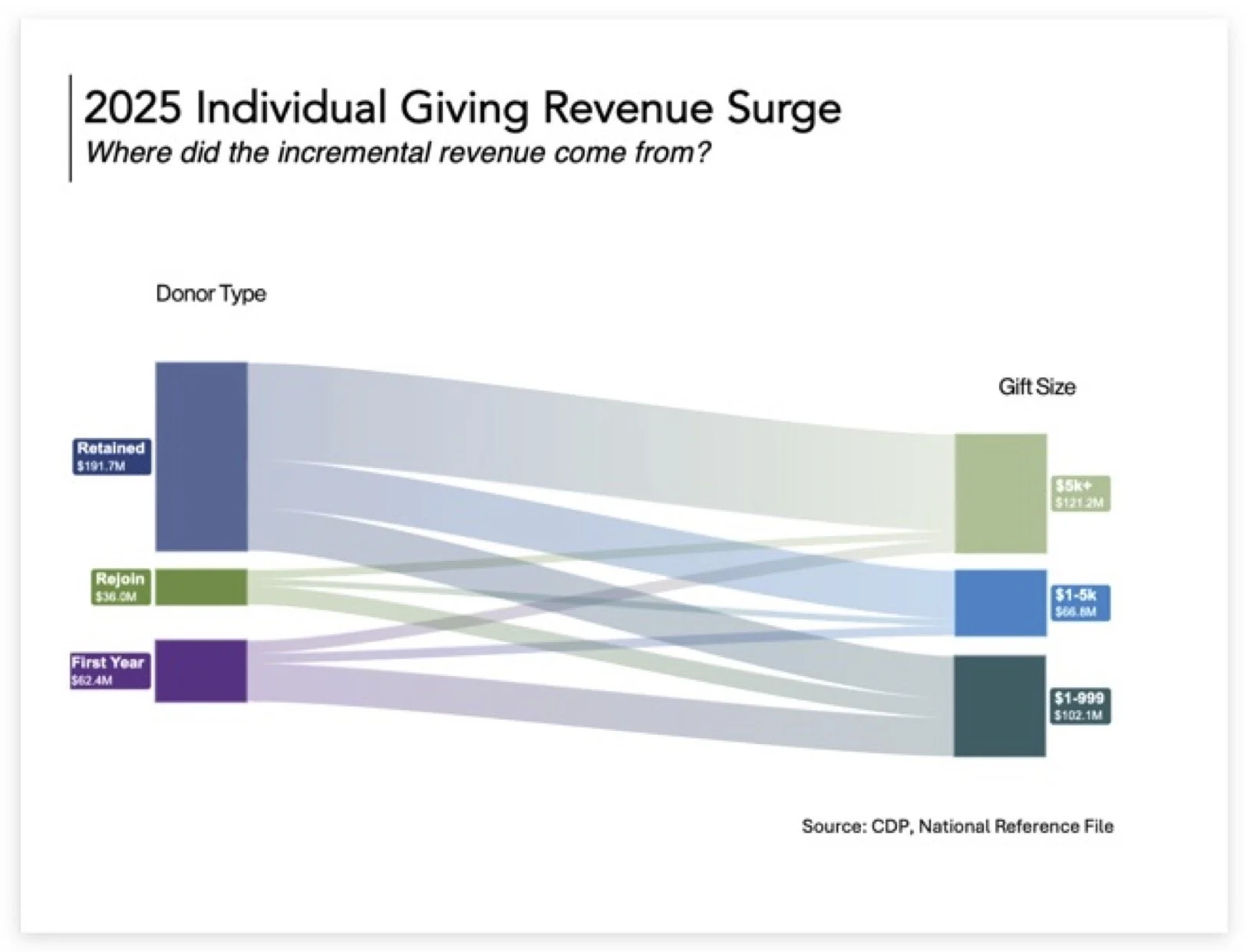
The scale of this shift is breathtaking. Just five years ago, $1,000+ gifts represented only about 24% of our total revenue. Today, that figure has jumped to nearly 39%. This is an incredible vote of confidence in our work.
It’s also a once-in-a-professional-lifetime opportunity to make public media a much higher philanthropic priority for millions of people.
Beyond the "Crisis": Investing in the Public Square
Charitable giving data tell us that the value of crisis gifts declines year over year (put another way, people who give in times of crisis tend to decrease their gifts over time). As the crisis abates, they feel their gift isn’t essential. What’s also true is that the value attrition of these gifts is not inevitable. If we want to realize this unprecedented potential, we must respond to the deeper commitment these donors are demonstrating.
This moment is different from a typical disaster response; in those cases, damage is fixed, roads are rebuilt, and once the community is restored, the giving often ends. While crisis gifts are a reaction to a problem, our donors are raising their hands for something more permanent: long-term community sustenance.
Our donors aren't just helping us weather a storm; they have invested in the "public square," which is an ongoing community relationship. And this is a powerful foundation for ongoing support, if we can meet their investment with an equal commitment to stewardship.
The Power of the Personal Connection
How do we seize this moment? As the saying goes: People give to people. As our donors move into mid-level and major giving, many are looking for a relationship, not a transaction. If we want these newly-invested donors to move public media to the top of their philanthropic priority list, we must engage with them in a way we have never done before. To keep these supporters close, we need the human capacity to steward their generosity and share the impact of their next gift. Sustained major gifts require more than a seasonal campaign; they take a year-round, dedicated presence in the donor's life.
A Call to Action: Staffing is a Revenue Strategy
If you are finalizing your budget this month, we encourage you to be bold and visionary. We encourage you to ask: “Is my station’s staffing sufficient to meet this incredible opportunity?”
Here are our recommendations:
Reassign, Hire, and Focus: Take a fresh look at your station’s entire development team. Every time you add a dedicated professional to a mid-level or major giving portfolio, you are opening the door for more donors to feel seen, valued, and inspired to stay. Hiring mid-level and major giving staff has a well-established return on investment (ROI) and has been proven across multiple parts of the non-profit sector, including public media, as one of the most efficient ways to generate incremental increases in revenue.
Give Your Team the Tools to Succeed: Beyond staffing, equip your development team with the best tools, technology, and reliable practices! Stations that have applied a disciplined, focused, data-based methodology to their major giving work have seen reliable results.
You have the donors who embrace your mission and love the work your team does for your community. We have a mission that improves the quality of life in our communities and brings people together.
Now, let’s make sure we have the people in place to bridge the two. Let’s embrace this high-water mark and invest in the staff who will secure our future. Together, we can turn this moment into a permanent foundation to ensure the growth and vitality of public media in the 21st century.